
IMO regulations
The International Maritime Organization (IMO) regulates air pollution from vessels through MARPOL Annex VI, the global framework for controlling emissions of sulphur oxides (SOx), nitrogen oxides (NOx), and other pollutants.
These regulations aim to reduce the environmental and health impact of shipping, particularly in coastal and densely trafficked regions where emissions significantly affect air quality.
Emission Control Areas (ECAs)
Under MARPOL Annex VI, Emission Control Areas (ECAs) are designated regions where stricter measures are required to limit air pollution from global shipping.
These areas are established to reduce emissions of sulfur oxides (SOx), nitrogen oxides (NOx), and particulate matter, protecting both human health and the marine environment.
Within these areas, vessels must use fuel with a sulfur content not exceeding 0.10% m/m or apply an approved equivalent solution, such as exhaust gas cleaning systems (scrubbers).
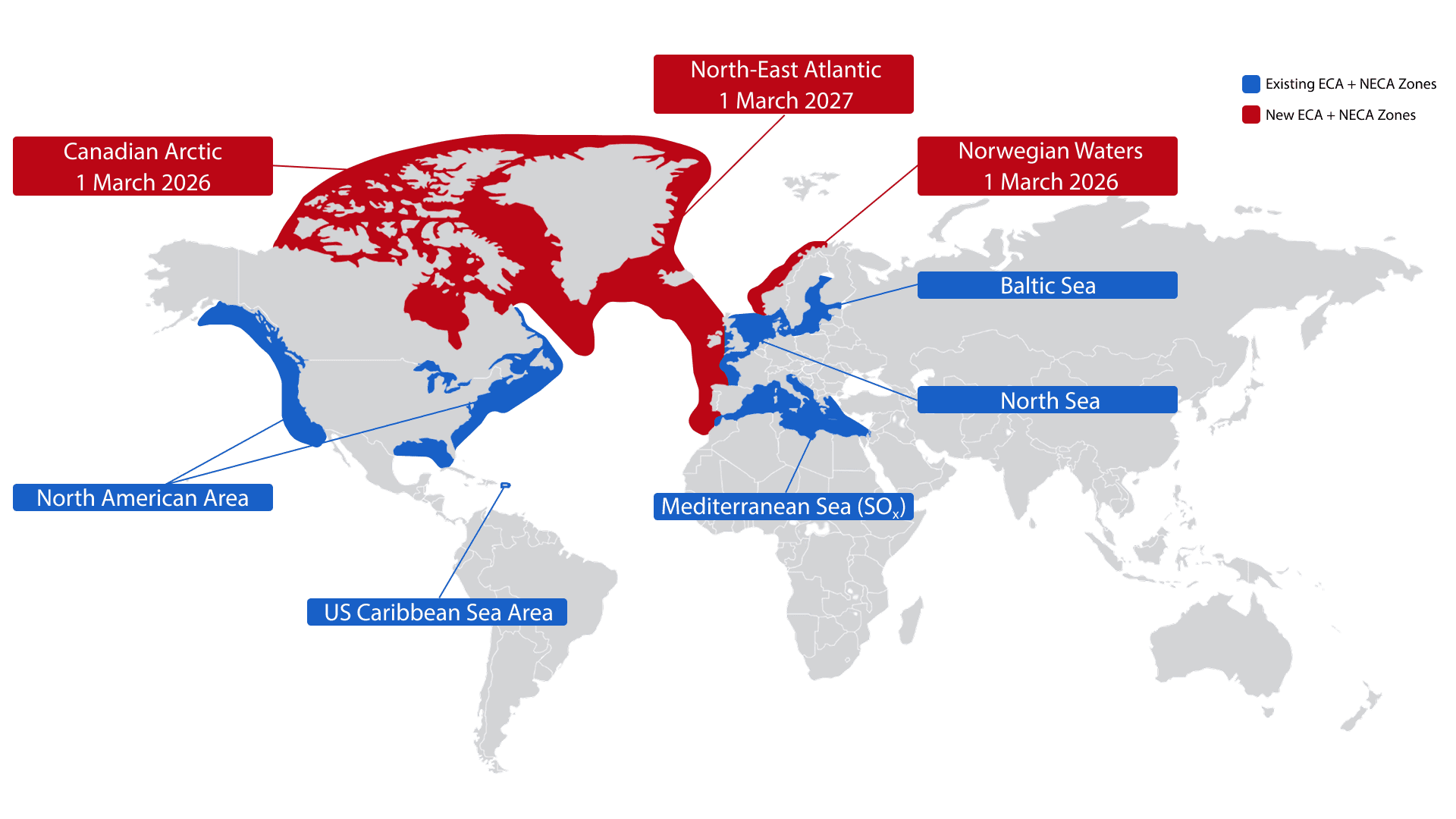
ECA zones are designated areas including the Baltic Sea, North Sea, North American and U.S. Caribbean regions, as well as the Mediterranean Sea.
NOx Emission Control Areas (NECAs)
NOx Emission Control Areas (NECAs) are designated under MARPOL Annex VI as regions where stricter limits on NOx emissions from vessels apply. These zones are typically established in areas with high environmental sensitivity, dense coastal populations, or increased exposure to air pollution.
Within NECAs, vessels keel laid after 2016 must comply with IMO Tier III standards, requiring a significant reduction – up to approximately 80% – in NOx emissions compared to earlier limits. Achieving this typically involves advanced emission-control technologies such as SCR or EGR systems.
NECA zones currently include North America, the U.S. Caribbean, the North Sea and Baltic Sea – and from March 1, 2026 also Canadian Artic and Norwegian Waters.
Global Emission Control Areas (ECA and NECA)
Global Sulphur Cap 2020
To reduce air pollution from shipping, the International Maritime Organization (IMO) introduced the Global Sulphur Cap on 1 January 2020. This regulation limits the sulphur content of marine fuels to 0.50% m/m worldwide, with stricter limits of 0.10% m/m applied in designated Emission Control Areas (SECAs).
Compliance can be achieved either by using low-sulphur fuels or by applying approved equivalent methods, such as Exhaust Gas Cleaning Systems (EGCS), commonly known as scrubbers. These systems enable vessels to continue operating on higher-sulphur fuels while ensuring that sulphur oxide (SOx) emissions remain within regulatory limits.
To demonstrate compliance, vessels must document and verify that their chosen solution consistently performs within the required thresholds. This places increasing importance on monitoring, documentation, and transparent reporting of emissions performance.
Need help navigating IMO regulations?
If you are navigating in current and upcoming IMO regulations, optimizing emission monitoring or preparing for future fuels – lets get in touch